Introduction
About
SmoothCrawler is a Python framework for web application crawler. It’s core concept is SoC (Separation of Concerns). In SmoothCrawler realm, the major components of a web spider are:
Sending HTTP request
Receive and Parse HTTP response
Data process of the parsed HTTP response data
Persistence
Let’s draw a simple work flow about it:
.drawio.png)
So we clear that what things it would do and the procedure of them, we could try to draw a activity sequence diagram:
.drawio.png)
The state of each processes is still unclear and it’s not enough to verify the detail of entire system. Let’s carefully consider about each processes.
Sending HTTP request
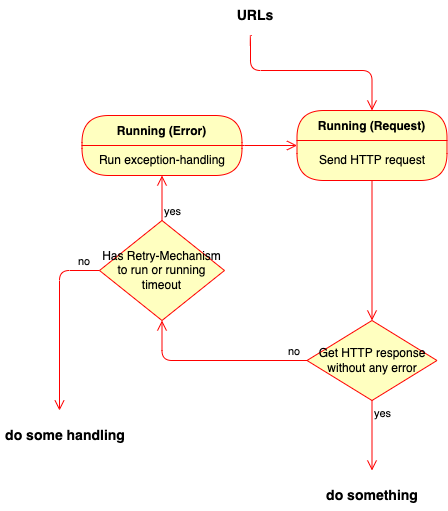
What are the problems it may face in process of sending HTTP request? One of them absolutely is retry mechanism. So it must has a retry mechanism in process of sending HTTP request like below:
Receive and Parse HTTP response
Sometimes, it’s so complex to process the HTTP response object. Actually, the most parts of web spider program would be parsing content of HTTP response. So there is another one object is responsible of parsing process.
Data process of the parsed HTTP response data
It won’t be the final data after it parses HTTP response object. It also has an object has responsibility of processing data.
Persistence
No matter you want to save data as one specific file format or save data into database, all the implementation and its related process should be in one object to do this.
Finally, from above all info, we could draw a activity sequence diagram with detail:
.drawio.png)
Let’s clear them with lanes pool diagram to display the relation between each processes and objects (classes) with activity sequence diagram:
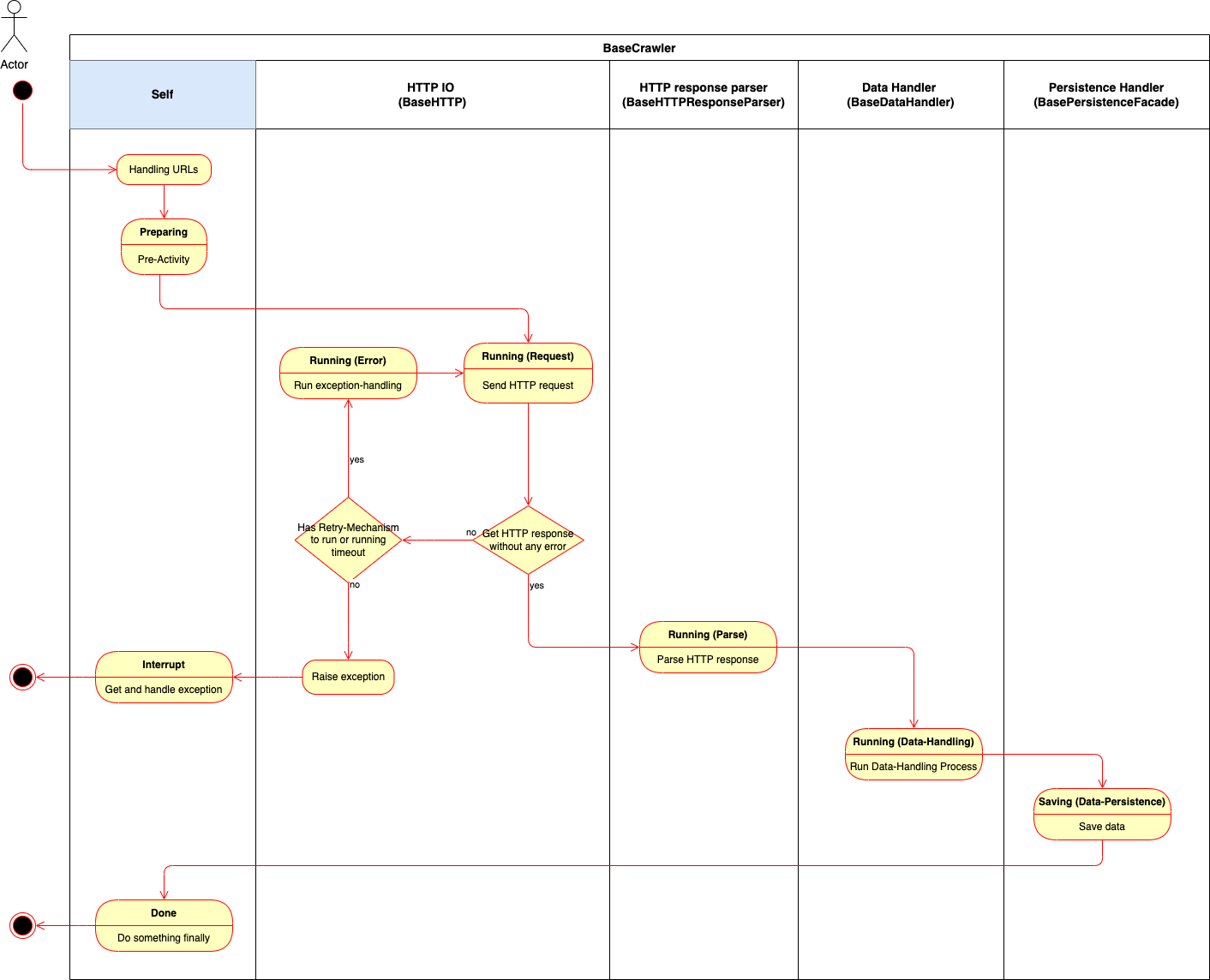
Therefore, SmoothCrawler has different objects which has their own responsibility of different concern. Each one object is a component, it could combine different components to a different crawler object. However, some components could be reused again and again if it needs for different crawlers. In the other hand, it could freak easily change one (or more) specific component(s) to other one(s).
Important
SmoothCrawler provides a software architecture to everyone to follow. In the other hand, it MUST TO IMPLEMENT the detail of each components it needs. For example, it should implement the sending HTTP request with library urllib3 or requests. And for the HTTP response parser, it should implement it with library like bs4 or something else.
SmoothCrawler is a FRAMEWORK. And it’s ONLY a FRAMEWORK without any implementations you need.
Comparison
You may ask yourself one question: Do I need SmoothCrawler to develop a web spider? The answer is: absolutely not. To use it or not to use it? Up to you. But the thing you should more necessary to consider is: what’s the problem you may to face in developing a web spider? Let’s demonstrate 2 implementations with old way:
from bs4 import BeautifulSoup
import requests


class ExampleOlderCrawler:

    def main_process(self, url: str) -> requests.Response:
        # Implement all things in a function. It even doesn't has retry mechanism.
        try:
            _response = requests.get(url)
        except Exception as e:
            print("Do something handle error.")
        else:
            _bs = BeautifulSoup(_response.text, "html.parser")
            _example_web_title = _bs.find_all("h1")
            _data = _example_web_title[0].text
            return _data
From above one, you could find that all logics are complexity with each others. It even doesn’t have retry mechanism.
But you may still think: it’s okay, I think it’s still clear to me. So let’s demonstrate another one:
import urllib3
import json


class StockOlderCrawler:

    def main_process(self, url: str):
        _http = urllib3.PoolManager()
        # _random_sleep = random.randrange(0, 10)
        # time.sleep(_random_sleep)
        try:
            _response = _http.request("GET", url)
        except Exception as e:
            print("Do something handle error.")
        else:
            _data = _response.data.decode("utf-8")
            _result_json = json.loads(_data)
            _result_data = _result_json["data"]

            _final_data = []
            _data_row = []

            for _d in _result_data:
                # # stock_date
                _data_row.append(_d[0].replace("/", "-"))
                # # trade_volume
                _data_row.append(int(_d[1].replace(",", "")))
                # # turnover_price
                _data_row.append(int(_d[2].replace(",", "")))
                # # opening_price
                _data_row.append(float(_d[3]))
                # # highest_price
                _data_row.append(float(_d[4]))
                # # lowest_price
                _data_row.append(float(_d[5]))
                # # closing_price
                _data_row.append(float(_d[6]))
                # # gross_spread
                _data_row.append(str(_d[7]))
                # # turnover_volume
                _data_row.append(int(_d[8].replace(",", "")))

                _final_data.append(_data_row.copy())
                _data_row[:] = []

            return _final_data
No matter sending HTTP request, parse the HTTP response and data process. They all are deeply complexity with each others. If it has more complex data process, the code would be more dirtier and less unreadable, much less handle other content of HTTP response which maybe more complex.
Therefore, SmoothCrawler resolve the issues with SoC to let web spider could be more readable, clearer and more easier of software maintainability.
Quickly Demo
For the moment, let’s demonstrate one of implementation ways because it’s more easier. If you’re very curious, please refer to the topic to get more detail how to use it.
Let’s install package and other dependencies you need:
pip install smoothcrawler requests bs4
Implement a SimpleCrawler:
from smoothcrawler.crawler import SimpleCrawler
from bs4 import BeautifulSoup
import requests


class ExampleEasyCrawler(SimpleCrawler):

    def send_http_request(self, method: str, url: str, retry: int = 1, *args, **kwargs) -> requests.Response:
        # Implement the sending HTTP request via library 'requests'
        _response = requests.get(url)
        return _response


    def parse_http_response(self, response: requests.Response) -> str:
        # Implement the parsing HTTP response via library 'bs4'
        _bs = BeautifulSoup(response.text, "html.parser")
        _example_web_title = _bs.find_all("h1")
        return _example_web_title[0].text


    def data_process(self, parsed_response: str) -> str:
        # Do nothing in data process
        return parsed_response
Let’s run the crawler via function run:
_example_easy_crawler = ExampleEasyCrawler()
_example_result = _example_easy_crawler.run("get", "http://www.example.com/")
print(f"Example web crawler result: {_example_result}")
# Example web crawler result: Example Domain
See? Each functions has their own responsibility, it works clearly and finely. That’s the point of SmoothCrawler.